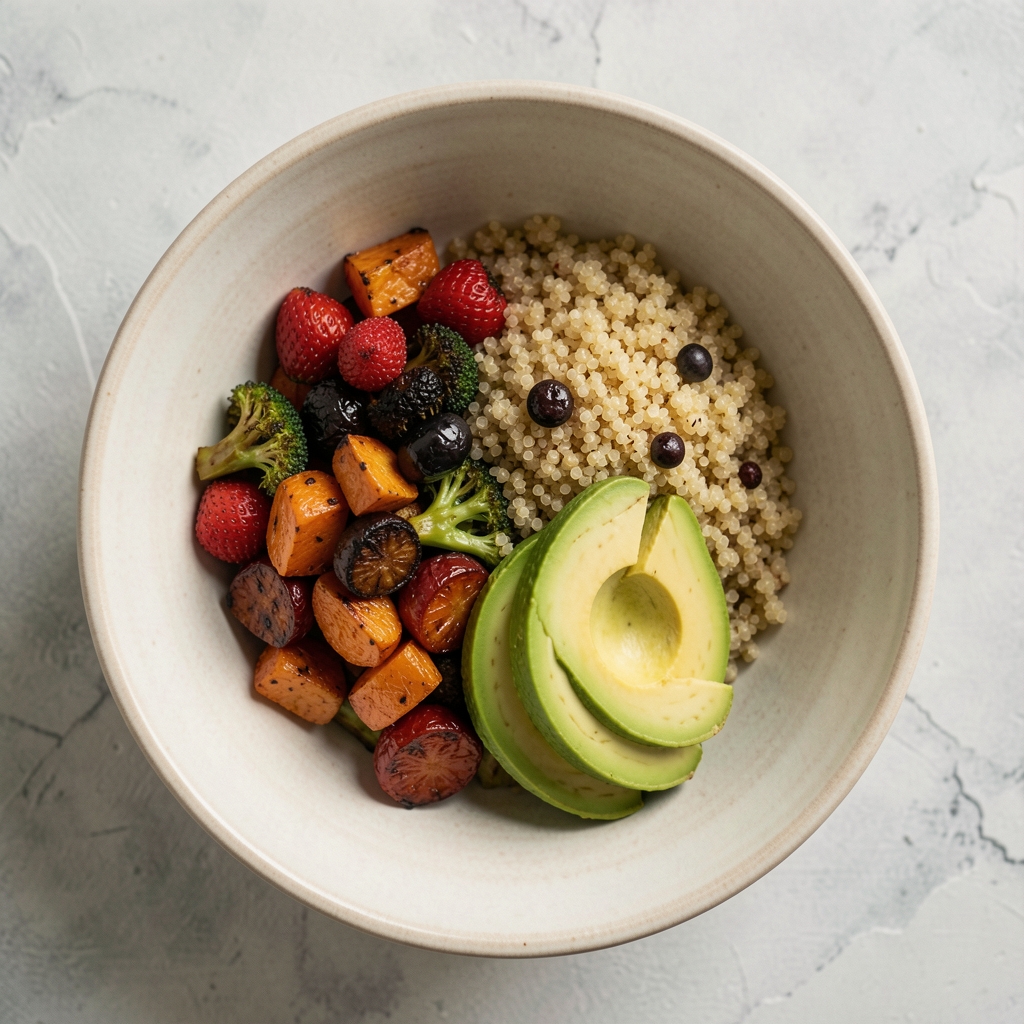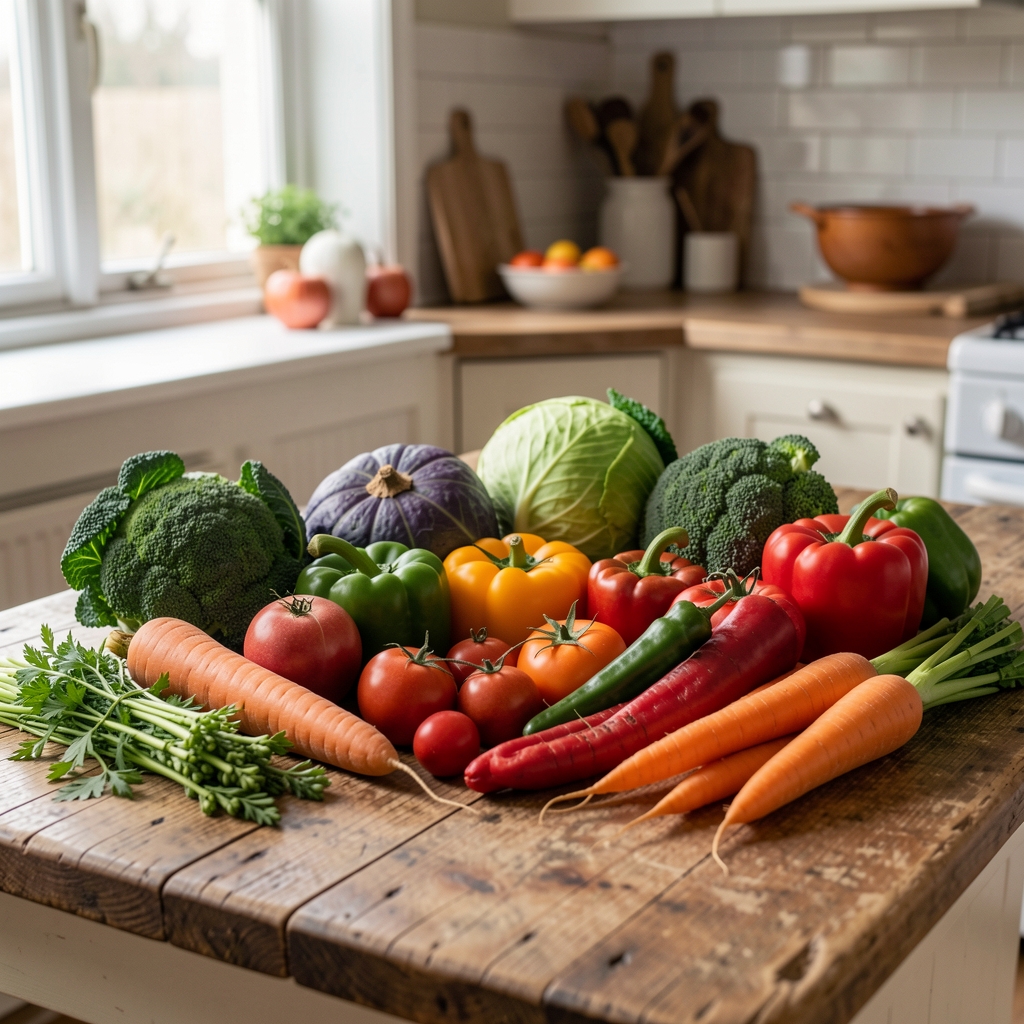
There is a particular quality to the act of choosing food in January that differs from choosing it in July. Not because January offers scarcity — the modern British supermarket has largely abolished the experience of genuine shortage — but because the produce available in January, if you pay attention to it, carries a different instruction. Root vegetables, dark leafy greens, stored squash: these are dense, slow foods. They take time to prepare. They reward patience rather than speed. And in following their logic, the kitchen becomes a place of a different kind of attention.
Seasonal eating, as a nutritional practice, is often discussed in terms of what it adds: higher vitamin content in freshly harvested produce, greater variety across a twelve-month span, the flavour improvement that comes from eating something at its natural peak. These observations are grounded in published nutrition literature and worth repeating. But the more interesting effect — and the one less often discussed — is what seasonal eating does to the structure of a daily routine.
The Calendar as a Menu Framework
Meal planning is typically approached as a weekly exercise. On a Sunday, some people write down five dinner ideas. They check what they already have. They make a list. This is useful, but it operates at a short time horizon. Seasonal awareness extends the frame. When you know that broad beans arrive in late spring and disappear within eight weeks, the week's menu becomes a small decision within a larger, year-long pattern of eating.
For those working on portion control and calorie awareness, this shift in time-horizon matters more than it might initially seem. Research on dietary habits consistently notes that variety is one of the strongest predictors of long-term dietary quality. A seasonal approach to grocery planning introduces variety not as a weekly effort — trying something new for novelty's sake — but as a structural consequence of following what is actually growing. The effort involved is low. The variety produced is high.
Nutritionist guidance on the topic tends to converge on a straightforward observation: people who build meals around what is seasonal and locally abundant tend to consume a more genuinely diverse range of vegetables and fruits over the course of a year than those who rely on the same reliable staples regardless of the time of year. The difference is not dramatic week to week. Compounded across twelve months, it becomes substantial.
Winter: The Case for Root Vegetables
The British winter produces, in abundance, ingredients that are nutritionally excellent but aesthetically unglamorous. Parsnips. Turnips. Celeriac. Jerusalem artichokes. Swede. These are not the foods that populate wellness imagery. They are not photogenic in the way that a summer plate of heritage tomatoes and basil is photogenic. And yet, considered as vehicles for a fibre-rich diet — one of the most reliably beneficial nutritional patterns in published research — they are outstanding.
A roasted root vegetable tray is, in dietary terms, a delivery mechanism for prebiotic fibre, complex carbohydrates, and a range of micronutrients including folate, potassium, and vitamin C. It requires little technical skill. It produces leftovers that form the basis of the next day's lunch. It is cheap. And it aligns with what the season actually offers rather than what a year-round supply chain can provide at the cost of flavour and some nutritional value.
The gut-friendly aspect of these vegetables deserves particular attention. A fibre-rich diet has been associated in multiple large-scale studies with improved gut microbiome diversity — a marker that nutrition researchers increasingly treat as a proxy for broader aspects of wellbeing. Winter root vegetables, particularly those in the allium family (leeks, onions, garlic), provide both fermentable fibre and flavour compounds that make a plate feel complete without the addition of high-calorie sauces or refined carbohydrates.
Spring and the Transition Plate
The period between late February and early May is, nutritionally speaking, a transition moment. Winter stores are depleting. The first spring produce — asparagus, purple sprouting broccoli, wild garlic, early peas — begins to arrive at market, but only for a few weeks at a time. This transience, which can seem like inconvenience, is actually one of the more useful structures that seasonal eating imposes on a routine.
When asparagus is available for eight weeks, it does not become a background item. It receives attention. It is the thing you are eating this fortnight, and then it is gone, and its absence creates the space for the next arriving ingredient. The plate becomes a record of where the calendar is. A food journal maintained during a seasonal eating year becomes, in retrospect, a surprisingly legible document — the presence of certain ingredients dating entries as surely as a written date.
For meal planning purposes, the transition season rewards flexibility over rigidity. A weekly menu written in early March should leave space for the discovery that purple sprouting broccoli arrived at the market on Wednesday. This kind of loose structure — anchor meals that use storecupboard staples, flexible slots that respond to market availability — is one of the more practical meal planning approaches for people trying to maintain nutritional variety without the exhaustion of highly detailed weekly plans.
Summer: Abundance and the Risk of Monotony
Counterintuitively, summer is the season during which a nutritionally aware eater most needs to pay attention. The abundance of summer produce — courgettes, tomatoes, cucumbers, salad leaves, beans, corn — can, if you are not deliberate, lead to a kind of colourful monotony. The plate looks varied because the colours are vivid. But a diet based predominantly on high-water-content summer vegetables can be low in the dense, slow-release carbohydrates and fibre that winter cooking delivers almost automatically.
Summer meal planning benefits from the deliberate inclusion of legumes — lentils, chickpeas, cannellini beans — which provide protein and fibre that summer salad ingredients do not. The combination of a fresh summer salad base with a portion of warm legumes and a small amount of whole grains produces a meal that is nutritionally complete, genuinely seasonal in character, and satisfying at the level of appetite rather than merely pleasant to eat.
Autumn and the Return of Depth
September's arrival brings a shift back toward depth. Squash, pumpkin, wild mushrooms, apples, pears, quince. The kitchen becomes warm again. The meal becomes slower. For those who found summer eating slightly light — enjoyable but not grounding — autumn offers a natural correction.
From a nutritional standpoint, the autumn harvest is one of the most generous of the year. Squash varieties, often underused in British kitchens, are excellent sources of beta-carotene, vitamin C, and dietary fibre. Wild mushrooms — available from foragers and some specialist markets through autumn — contain compounds including ergosterol that contribute to vitamin D synthesis when dried in sunlight, a particularly relevant consideration in a country with limited UV exposure from October to April.
An autumn meal plan might anchor itself around two or three squash-based dishes per week — roasted, pureed, or used in a warm grain bowl — supplemented with seasonal leafy greens such as kale and chard, which become reliably available and excellently flavoured once the first frosts arrive.
Building the Seasonal Habit
The practical challenge of seasonal eating is not knowledge — most people can identify the broad seasonal categories without difficulty — but habit formation. The existing kitchen routine, with its reliable staples and known cooking methods, exerts a strong pull. Introducing seasonal variation requires a small, consistent investment of attention at the grocery planning stage.
One approach that the editorial team at Oraluna Press has found reliably useful: the standing weekly market visit. Not to replace supermarket shopping, but to precede it. Thirty minutes at a farmers' market or a good greengrocer once a week reveals what is actually arriving, what is at its peak, and what represents genuine value. The meal plan for the week is then shaped around these discoveries rather than produced in the abstract and filled in at the supermarket.
A second approach: the seasonal reference. A simple list — updated twice per season — of which vegetables and fruits are currently at their best in the UK. This does not need to be comprehensive. Eight to ten items per season is sufficient. It functions as a prompt rather than a directive, keeping the seasonal frame present without requiring expertise.
Over the course of a year, a kitchen organised around seasonal eating tends to acquire a kind of rhythm. The kitchen routine in November is recognisably different from the kitchen routine in June. This differentiation — far from feeling restrictive — tends to sustain engagement with cooking over the long term. The plate does not become boring, because the plate does not stay the same.